
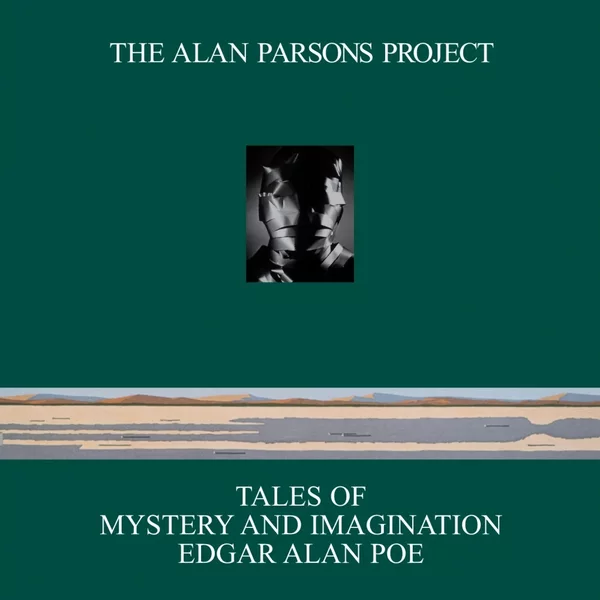
Some 30 years ago, I chanced to come across a peculiar concept album from times immemorial, abandoned in the dusty crates of a second-hand record store. I had just recently become fascinated by the Gothic novels of Edgar Allan Poe, so I simply had to rescue this particular double-vinyl to a good home. The album in question was THE ALAN PARSONS PROJECT‘s conceptual debut affair from the mid-1970s, which was basically a homage to Poe’s literary works. The later, 1987 CD reissue of this album had some re-recorded stuff thrown in for good measure, but I’m talking about the original Charisma Records vinyl edition here. When the dark-ish green album cover popped into my field of vision at the local vinyl pusher’s shop, I was already quite familiar with Alan Parsons‘ producing genius through such album classics as “The Dark Side of the Moon” by PINK FLOYD, so there was no way I was going to leave this gem just lying there. What I didn’t know at the time was that THE ALAN PARSONS PROJECT was actually a joint venture by Parsons and session pianist Eric Woolfson, the latter of whom actually wrote most of the material for their albums. Woolfson also handled the vocals while Parsons ensured that the production side of things was top-notch. This dynamic duo released ten albums altogether between 1976 and 1987, and the conceptual template for all these future albums was set by this debut affair, released on May 1st, 1976, via Charisma Records. On some later albums, the concept is rather loose, but on this debut, the concept was very literal, with each of the album’s seven tracks being a musical adaptation of a famous short story or a poem written by Poe. The music is often regarded as progressive rock, but it’s far more radio-friendly than, say, Rick Wakeman‘s conceptual endeavors from the same era. If I’m completely honest, I wasn’t really sure what to think about this album when I first put it on as a twenty-something prog nerd.
The album kicks off with a shortish instrumental entitled “A Dream Within A Dream.” The title comes from a 1849 poem, the most famous lines of which have been used in myriad films over the decades – “Is all that we see or seem but a dream within a dream?” The cascading piano in the first half of the song is indeed rather dreamlike. Then, halfway into the song, a stomping bassline and dreamy guitars take over, bleeding into one of the highlight tracks of the album, “The Raven.” The poem by the same name is arguably the most renowned piece in Poe’s whole body of work, so it stands to reason that the album pays homage to it with its best track. Parsons himself tackles the vocals with the help of Leonard Whiting and a Vocoder, and the song is basically an epitome of that mid-1970s radio-friendly prog – well, y’know, SUPERTRAMP and the like. I guess it was the Zeitgeist, because there is something very similar, in terms of production and the overall vibe, in the Finnish prog album, “Lucky Golden Stripes and Starpose,” released by WIGWAM in 1976 as well.
Next up, “The Tell-Tale Heart” is another stomping prog-boogie that slightly side-steps in the DEEP PURPLE sandbox, with the proto-heavy-metal knob turned down a notch, of course. Maybe the impression comes from Arthur Brown‘s flamboyant and theatrical lead vocals that reach into an almost Ian Gillan-like sphere here and there. If the name rings a bell, well… Yeah, it’s the dude from THE CRAZY WORLD OF ARTHUR BROWN that gave us the blockbuster song, “Fire,” in the late 1960s. While this song is by far less frantic, you cannot help but sense a somewhat familiar vibe in the song. The orchestrations are particularly well done, courtesy of Andrew Powell, who would not only continue with THE ALAN PARSONS PROJECT on all of their future albums, but he also produced Kate Bush‘s first two albums shortly after this endeavor.
Speaking of which, the next highlight of the album, “The Cask of Amontillado,” is not only a homage to the short story by the same title, but also a nod towards THE BEATLES with some haunting orchestration. The lead vocals are tackled by John Miles and Terry Sylvester, whose vocal harmonies are a dead ringer for those of Paul McCartney and John Lennon. What makes the song really stand out, however, is Powell‘s magic touch with the orchestral arrangement.
For some reason, “(The System of) Doctor Tarr and Professor Fether” is the most-streamed song from this album on Spotify. It has garnered way over 4 million streams, while the other tracks have been left far behind. I mean, the song is pretty good with its STEELY DAN groove and all, but it’s not even the second-best track in this selection. Then again, I reckon the doo-wop vocals, courtesy of John Miles and Jack Harris, might have something to do with it. The chorus could fit into an EARTH, WIND & FIRE song like nothing to it.
Okay, so far, the album has not really served any curveballs. What comes next, however, did sound a bit confusing to the twenty-something version of me back in the day. The vinyl side B is mostly comprised of a 5-part classical music suite, “The Fall of the House of Usher,” with rock instruments thrown in here and there to add a little bit of bite. The orchestrations are nothing but sublime, of course, but this was definitely something that I wasn’t expecting from a prog-rock album some 30 years ago. Now, I think I like the ”B side” even better than the ”A side”. Some sections of this suite do, in fact, resonate with the air of “Sirius,” one of the band’s biggest hits to come from that 1982 album of theirs. My favorite parts are the second and fourth – “Arrival” and “Pavane,” respectively. The latter even features the Finnish folk instrument, kantele, played by guest musician John Leach.
Finally, the album is brought to a close with “To One in Paradise,” another tribute to the mellow pop of THE BEATLES. So, what do we have here? Radio-friendly prog riffers, sideways glances to this one Liverpool four-piece, and tons of classical music. I’d say that must have been quite a lot to handle 50 years ago. Then, due to the project-like nature of this whole endeavor, the guest list is extremely long, and it doesn’t even list the lineup of the orchestra. I guess TAPP must have been pioneers in this respect; in this day and age, it’s business as usual that you need a whole booklet for listing all the guest musicians on a prog-rock endeavor.
“Tales of Mystery and Imagination” is undoubtedly one of THE ALAN PARSONS PROJECT‘s best albums, although it has become something of a hidden treasure over the years, overshadowed by later TAPP endeavors such as “Pyramid” (1978) and “Eye in the Sky” (1982). In the vinyl version, side A could be regarded as progressive rock, albeit somewhat eccentric and light at that, while side B is straight-up classical music with rock instruments thrown in for seasoning. The later CD reissues feature narration by Orson Welles in the vinyl side intros, which are actually pretty cool. For some reason, this album doesn’t seem to get the recognition it deserves, so I reckon, with the album turning 50 just as we speak, it is high time to put in a good few words for this fine endeavor.
Written by Jani Lehtinen
Tracklist
- A Dream Within A Dream (Instrumental)
- The Raven
- The Tell-Tale Heart
- The Cask of Amontillado
- (The System of) Doctor Tarr and Professor Fether
- The Fall of the House of Usher: Prelude (Instrumental)
- The Fall of the House of Usher: Arrival (Instrumental)
- The Fall of the House of Usher: Intermezzo (Instrumental)
- The Fall of the House of Usher: Pavane (Instrumental)
- The Fall of the House of Usher: Fall (Instrumental)
- To One in Paradise
Lineup
Joe Puerta – bass (tracks 1, 2)
Stuart Tosh – drums (tracks 1-5, 7, 9, 11), timps and backwards cymbals (track 3)
Burleigh Drummond – drums (track 2)
Alan Parsons – lead vocals (track 2), Projectron (track 3, 7), backing & additional
vocals (track 4, 11), recorders (track 5), synths (track 7)
Billy Lyall – keyboards (track 1, 3), piano (track 4, 5), recorders (track 1), Fender
Rhodes (track 11), glockenspiel (track 11)
Darryl Runswick – string bass (track 9)
Leonard Whiting – lead vocals (track 2), narration (track 11)
Eric Woolfson – electric guitars (track 1), keyboards (tracks 1-3, 5), harpsichord
(track 4), keyboard loop (track 7), organ (track 7), backing & additional vocals (track
2, 11)
Francis Monkman – organ (track 7), harpsichord (track 9)
John Leach – cimbalom & kantele (track 9)
Christopher North – keyboards (track 2)
Ian Bairnson – electric guitars (tracks 1-4, 7, 11), acoustic guitars (tracks 1, 11)
David Paton – acoustic guitars (tracks 1, 11), backing vocals (track 1), bass (tracks
3-5, 7, 11)
David Pack – guitars on track 2
Bob Howes and the English Chorale – choir (tracks 2-4)
Arthur Brown – lead vocals on track 3
Jack Harris – additional vocals on tracks 3 and 5
John Miles – lead vocals on tracks 4 and 5
Terry Sylvester – additional vocals (track 4), lead vocals (track 11)
Les Hurdle – bass on track 6
Laurence Juber – acoustic guitars (track 9)
Kevin Peek – acoustic guitars (track 9)
David Snell – harp (track 9)
Andrew Powell – orchestrations (tracks 2-4, 6, 8, 10), organ (track 9)
Westminster City School Boys Choir – choir (track 11)
Jane Powell – backing vocals (track 11)
Label
Charisma Records (UK) / 20th Century Records (worldwide)