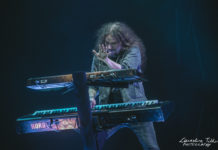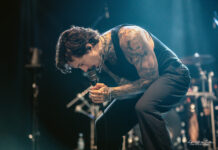

We caught up with bass player Ole-Pekka Laine and drummer Jan Rechberger of AMORPHIS to talk about their upcoming album Borderland, diving into its creative process, new production approach, and what fans can expect from the record. Read the full interview below.

Thank you so much for taking the time to do this pre-listening experience. How was it for you guys today?
Jan: Well, fun, I guess. You know, there was also whiskey tasting and stuff like that, since we’re launching a whiskey alongside the album. It’s always exciting to have people listen to the record and get some feedback.
Oppu: Yeah, that’s right. We had a similar session in Germany a few weeks ago with media from Germany and Central Europe. It’s really nice to have Finnish media hear the album as well and see what the response will be.
What kind of feedback have you received so far from journalists?
Jan: Over here? I haven’t really had the chance to talk to anyone yet. I hope it’s positive. I’ve just heard bits and pieces—people mentioning random songs—but no overall feedback yet. It’s been quite busy, so there hasn’t been much time to talk.
Oppu: It was the same in Germany—we didn’t really have time to hang out with journalists after the listening session. So it’s hard to say, but I got the feeling that it was a positive experience overall.
Jan: I hope so.
Oppu: Yeah, me too.
I guess you can often tell from people’s reactions and expressions as well. One major change on this record is the production—you worked with Jacob Hansen this time. Why did you choose him?
Jan: I think things tend to move in cycles for us. In the past, we’ve often worked in groups of three albums with certain teams, ever since “Eclipse.” The only exception might be “Circle,” which we did with Peter Tägtgren. After that, we did three albums with Jens Bogren.
It felt like the end of an era, and we needed something fresh. Changing the producer is always a good way to push things in a new direction. Also, songwriting-wise, everyone contributed material this time, and it all aligned quite naturally.
Oppu: Yeah, it was kind of a stylistic decision to treat the Jens Bogren albums as a trilogy—with Valnoir doing the artwork and Jens handling production. But it was time to move on.
Jacob Hansen has a background in death metal, but he also works with more mainstream metal bands like VOLBEAT. His range is very wide, so we thought he could be a good fit—and luckily, he agreed. He has his own studio in Denmark, so the whole process was quite smooth after pre-production. I think it was a good choice.
What kind of effect did the new production have on your sound and your instruments?
Jan: Personally, I felt we had more artistic freedom this time. Even during pre-production, we didn’t change much in terms of song structures or compositions. The recording process was very relaxed and experimental. It felt like we could express ourselves more freely.
Oppu: Yeah, he didn’t affect the arrangements as much as Jens did. Jens had a very precise, almost clinical approach, which was great in its own way. This time, it feels more organic—more like a true band album. Both approaches have their strengths; it depends on your taste.
Jan: Also, the material was more refined from the start. The arrangements were already quite complete, so we didn’t need to make many changes. That naturally made the whole process feel more intuitive.
When did you start writing the album? What was the overall timeline, especially with touring and side projects?
Oppu: I think people in this band are always writing music. When someone has five or six songs ready, that’s when we start thinking about an album.
For me, it’s a continuous process—I’m not someone who writes everything in one intense period. I could revisit a ten-year-old idea tomorrow and refine it.
Jan: Yeah, it has to come naturally. You can’t really force it. Of course, if I had to write something right now, I could—but it’s better when it happens freely.
Oppu: And since we’re touring so much between albums, it’s not even possible to write constantly. It happens in between tours.
You mentioned having more room to experiment. For me, “The Lantern” felt like the most experimental track. Can you tell me more about it?
Jan: It’s probably the most cinematic track on the album. It’s also the only song in an odd time signature—7/4—while the rest are more straightforward.
So in that sense, it might even be the most progressive track, even though it’s still quite simple. It’s very atmospheric and has a strong emotional feel.
The intro even felt a bit synthwave-inspired, which I didn’t expect from you. Are there other new elements like that on the record?
Jan: There are some synthesizer sequences and maybe some groovier rhythms here and there. But overall, I’d say it’s actually one of the most straightforward albums we’ve done in a long time.
Oppu: Maybe that’s exactly why those small experimental elements stand out more.
Jan: Yeah, because the overall approach is quite catchy and accessible.
The album also feels very dynamic, with softer and heavier sections interacting in a new way. Do you follow a specific songwriting formula, or did you move away from that?
Jan: That’s a good question. In the past, we’ve had both straightforward and more progressive material—especially on albums like “Halo,” “Queen of Time,” and “Under the Red Cloud.”
This time, I think the songs just naturally came out this way. It wasn’t intentional—it’s just how things developed.
Oppu: It might also have something to do with the producer. Jens sometimes restructured songs quite heavily—breaking them apart and rebuilding them. Jacob didn’t do that; he accepted the material as it was.
Jan: Yeah, we gave him around 25 tracks, and these are the ones he chose. There were actually more progressive songs in that batch.
Do you personally miss having more progressive elements on the album?
Oppu: I think it just wasn’t the time for that. This album needed to be more straightforward.
Jan: And to be honest, our “prog” has always been relatively subtle. There are bands that go much further in that direction than we ever have.
Oppu: “Halo” was probably more progressive, but also less accessible. It required more listening. This one opens up more easily.
Was making a more accessible album a conscious goal—perhaps to reach new audiences?
Jan: Not really. We don’t approach things that way. We just make music and see where it goes.
We don’t sit down and say, “Let’s make this kind of album.” It doesn’t work like that.
Oppu: That might be more of a producer’s perspective—thinking about what works for audiences. But we leave that to them.
Jan: There’s probably a reason Jacob chose these songs, but he’d be better at explaining that than I am.
Were there any songs left out that you would have liked to include?
Jan: Not really. I only wrote one track myself, so it’s hard to say.
Oppu: Maybe a couple of songs could have added some variation, but this is the direction Jacob chose. And that’s fine.
Some songs feel very cinematic. Are film scores or game soundtracks an influence for you?
Jan: Definitely. Film music is very close to my heart. I also enjoy classical music, cinematic compositions, world music, and electronic music.
You can probably hear small elements of all those influences in our music.
The cover art has also changed, and it reminded me a bit of Akseli Gallen-Kallela’s style. Why did you choose this artist?
Oppu: We had several options—maybe five artists—and we collectively chose this one. His style felt closest to something that could match a Kalevala-inspired aesthetic.
Esa and Tomi Joutsen worked closely with him and guided the direction. I’m not sure if they showed him specific Finnish paintings, but that was the general idea.
Kalevala themes have been a big part of your identity. How important is that to you personally as Finnish artists?
Oppu: It’s not really a conscious mission or anything patriotic. It just happened naturally. When we started, none of us were really lyricists, so we turned to that material.
Maybe the idea was influenced by bands like BATHORY using Norse mythology. It just evolved from there.
Jan: And it turned out to be a great fit. The folklore, the poetry—it matches the mood of our music perfectly.
Now that Pekka continues in that same universe with his own perspective, it still feels very natural.
It’s funny how something that started almost by accident became such a defining part of your identity.
Jan: Yeah—that just proves we’re getting old.
One of my favorite tracks is “Bones,” which also feels like one of the heaviest on the album. Can you tell me more about it?
Jan: It’s one of my favorites too. It was one of the first tracks that stood out to me from the demos.
It has very catchy riffs and some similarities to songs like “Death of a King,” with that slightly oriental melody. It balances both heaviness and melody really well—harsh elements alongside a strong, catchy chorus.
Oppu: I hope it makes it into the live set—it should be a lot of fun to play live.
The track also has a softer, more atmospheric middle section, which creates a nice contrast—similar to “Light and Shadow.” How has the reaction to that single been?
Jan: From what I’ve seen, it’s been well received. I was actually a bit worried it might be too soft for a first single, but people seem to like it.
Of course, you can’t please everyone—but overall, I’m very happy with the feedback.
It’s also surprisingly danceable.
Jan: Yeah, it’s quite catchy and easygoing.
I saw your social media manager describe one of the songs as a “disco track”—was that the one?
Jan: No, that would be “Dancing Shadow.”
Do you have any other interesting working titles from the album?
Jan: Yeah—“Light and Shadow” was originally called “Gym Song.”
You also released a whisky alongside the album. Can you tell us more about it?
Jan: It’s a collaboration with Helsinki Distillery Company. We’ve always kind of fantasized about having our own whisky, so when the opportunity came up, we went for it.
It’s a very high-quality product—something a bit more refined and classy.
Oppu: Yeah, it’s definitely high-end whisky. It’s been aged in different barrels—sherry, Laphroaig-style, and bourbon. I don’t know the exact durations, but it’s very carefully crafted.
There’s also Finnish rye in the ingredients, which gives it a unique character.
Jan: Yeah, and it tastes really good.
Were you involved in the development process?
Jan: Yes, we met with the distillery team and tasted different options. They had their expertise, of course, but we helped narrow things down. It was a very natural process.
Sounds like a fun experience. Looking ahead, what are your touring plans?
Oppu: One tour has already been announced—with ARCH ENEMY, ELUVEITIE, and GATECREEPER in October and November.
We’ll also have Finnish dates at the end of the year. And overall, we’re looking at at least three years of touring globally.
So a very busy period ahead.
Oppu: Yes—but also a lot of fun. There will be multiple European tours, and likely North and South America as well.
Alright, that’s all my questions. Any final thoughts for your fans?
Jan: Come see us live—
Oppu: —and buy “Borderland.” It’s a great album.
Jan: See you on the road!
Interview by Laureline Tilkin