

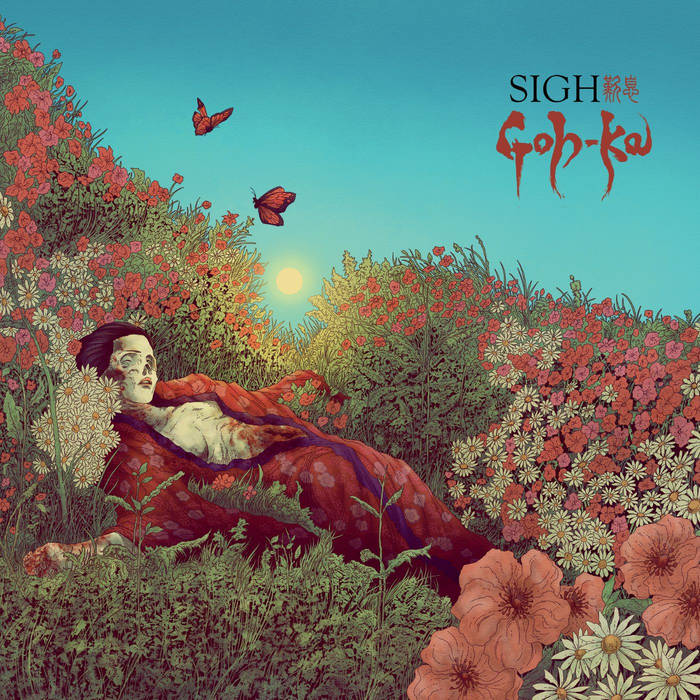
Japanese bands, pretty much regardless of genre, tend to smash whatever expectations you have about them, and SIGH is no exception. The band visited the Hellsinki Metal Festival last year, and their performance was a total mindfuck, to put it mildly. This wild bunch has been around for 30-something years, so they have more than enough mileage to claim a legacy; they started as a more traditional black-metal outfit in the early 1990s, but their sound has evolved into something far more eccentric, avant-garde, and progressive. Their new album “Goh-Ka” almost slipped by me entirely, but now that it popped onto my radar, it’s absolutely necessary to dig into it. Released in September via Peaceville Records, this new selection is their 13th album release overall, and given their pedigree discography, I guess it comes as no surprise that these new songs defy any preconceptions you may have had about Japanese black metal. Is this even black metal? I’m not sure. There seems to be an overarching theme of impermanence on this album, drawing inspiration from the Japanese art of Kusôzu – that is, watercolor paintings that depict the slow decay of a human body, usually female, from the first moment of death to the final stage of bare bones, with all the discolored and bloated steps in between. Charming, right? I guess that’s something black-metal bands and Zen Buddhists agree upon: that there is a distinct, albeit a bit macabre, kind of transcendental beauty in death. I assume the album cover represents this Kusôzu style with the stylized picture of a female body rotting away in the meadow. That’s black metal asf, I reckon, but the music is far less easy to pin down to a clearly defined genre.
The game is set off with a cinematic epic, “Kuso-shi 1, 2, and 3.” The song begins with an intro that gives you no warning whatsoever about what you’re going to hear. When the riffs start to roll in full, the traditional Japanese instruments stand out, in particular, elevating the song to a sphere of its own. I’m sure we have all seen these YouTube videos where some Asian wonder-kid drops a haunting cover rendition of some metal classic, playing shamisen or koto. This stuff is something else entirely, though. This is the real shit. SIGH does not sound like a black-metal band flirting with ethnic curiosities, but rather like an authentic Japanese trad-folk outfit flirting with extreme metal aesthetics. To be honest, I haven’t got a clue what genre this music is supposed to be: there is a lot of traditional Japanese folk, BLACK SABBATH, and black-metal flourishes. Mixed together, all these elements add up to a sonic concoction that probably shouldn’t work, not even in theory, but Mirai Kawashima and his squad make it work just wonderfully. When the band played inside the Helsinki Ice Hall last year, Kawashima swung a flaming samurai sword on stage at some point, and that surreal sight shall remain etched into my mind forever; it’s an apt metaphor for the band’s music as well – it’s thoroughly weird and exciting. The title of the album opener refers to the poems, Kuso-shi, written for the nine stages of a human body’s decomposition after death. These poems are used for meditation on the impermanence of life and the inevitability of death. The main takeaway is something like this: no matter how hot and unbothered you may appear now, sooner or later you will be dead and rotting away like anyone else. How comforting.
This Zen-like, no-nonsense approach to life permeates the band’s music throughout the album: there are no stupid gimmicks sprinkled in these songs. On paper, the use of traditional Japanese instruments in a (black-) metal context might seem like that, but when those instruments are used with confidence and authenticity, it doesn’t sound gimmicky at all. In this respect, “Unputenpu” is the album’s definitive standout track –it even features a guitar solo by Mikael Åkerfeldt! His trademark lyrical phrasing fits this weird, fever-dreamy music just fantastically. Now, I’m not familiar with Japanese folk songs, like not at all, but largely thanks to Marty Friedman, I have explored the sonic possibilities of certain Japanese pentatonic scales, and some of those incorporate a peculiar, ethnic vibe, something distinctly Japanese, and I can sense that particular vibe permeating SIGH‘s music. The longer epics, in particular, resonate with something utterly Japanese. Needless to say, these songs became my instant favorites from this album. What can I say? I wasn’t expecting a new album from these black-metal samurai, much less a mind-melting album like “Goh-Ka.” There are still a couple of months left of 2026, but I feel it’s safe to say that SIGH‘s new album is one of the absolute best released this year! I will have a hard time trying to figure out in what category I shall place this endeavor when it comes time to compile my Best of 2026 lists in December, no doubt. This is not merely a good album, but an insanely good one. And if you’re hesitating whether or not you could really immerse yourself in this type of eccentricism, you should at least listen to the epic closer, “Kuso-shi 8 and 9.” The song captures the very essence of the band and wraps it all into a 12-minute epic. It’s a fantastic closure for a beautiful sonic journey to the land of the rising sun.
Written by Jani Lehtinen
Tracklist
- Kuso-shi 1, 2, and 3
- Jigoku-Zoshi 1 – Unkamusho
- Anzenshokon
- Kuso-shi 4, 5, and 6
- Shoso
- Unputenpu
- Jinmenjushin
- Jigoku-Zoshi 2 – Tokatsujigoku
- Kushukankyo
- Kuso-shi 7
- Kuso-shi 8 and 9 – Mettaijakujo
Lineup
Mirai Kawashima – vocals
Dr. Mikannibal – vocals, saxophone
Nozomu Wakai – guitars
with guests:
Frédéric Leclercq (KREATOR) – bass
Mike Heller (RAVEN, MALIGNANCY) – drums
Mikael Åkerfeldt – guitar solo on “Unputenpu”
Label
Peaceville Records
Links
https://peaceville.bandcamp.com/album/goh-ka