
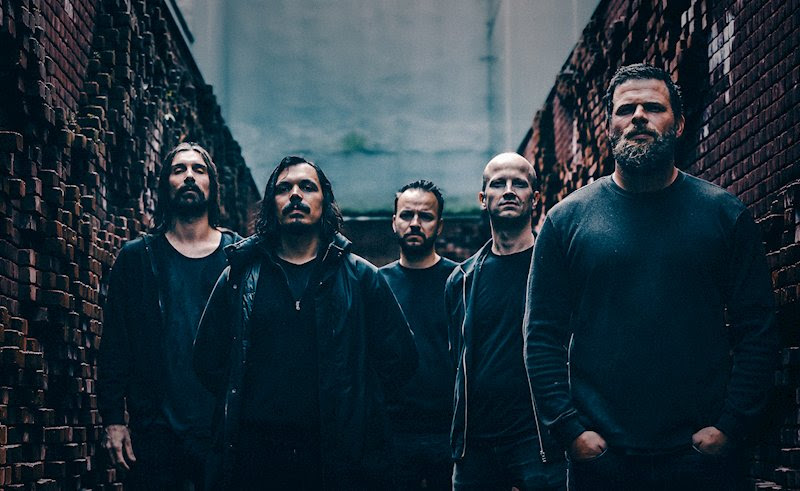
We sat down with Chiaran Verheyden, guitarist of HIPPOTRAKTOR, to talk about their new album, “Annihilist,” the songwriting process behind it, finding the right balance between complexity and keeping things raw, and how these songs will translate to the stage. We also talked about the Belgian metal scene, the crowds that give the most energy back, and the possibility of finally seeing HIPPOTRAKTOR in Finland.
Hi, thank you so much for taking the time to do this interview, especially on such short notice. How are you doing?
Thank you. Thank you for having me. I’m good, thank you. Yeah, all good.
You just released your new album, “Annihilist.“ How do you guys feel now that it’s finally out there for the world to hear?
Yeah, it’s a weird mixture of gratitude and also a bit of uncertainty, I think, because this is the time when reviews are coming in and people are listening, and this is the first time we’re actually receiving feedback. So it’s a bit of a surreal mixture, but overall, I think we’re very happy with how it’s been received so far. So, yeah, it’s going great.
Yeah, the feedback has been positive. I feel like I’d have a word with someone who gave you a bad review.
Yeah, for sure. I think it’s going better than I could have hoped for so far. So, yeah, I’m super excited.
Since you’re the main songwriter, has anything changed for you compared to the two previous albums, or was it more or less the same in terms of songwriting?
Yeah, for sure. With this one, I wanted to focus more on the building blocks and really focus on the songwriting itself without trying to have too much of a production extravaganza going on whilst writing. So today, it’s so easy to layer tons of guitars and all sorts of things to make your demo sound huge. But the big drawback is that if you’re doing too much of those things, then you might have a problem live. And I also think a good arrangement beats any overproduction.
So I think in the previous two records, there was more of that going on. With this one, it’s very honest. It’s always just a couple of guitars and just us, basically. So I really enjoyed this process. And I think it was difficult for the band because they’re used to receiving fully fleshed-out productions. This time around, I made sure they sounded like shit because I wanted them to judge the song and not the production.
And I mean, it wasn’t like I really tried to go for, you know, a shitty sound per se, but I really didn’t want to do any EQing or, you know, any sort of processing to make it shiny. These are just the raw guitars, the raw bass, and the raw drums. And let’s see if it sticks. So, yeah, I think this was a good challenge, let’s say.
That reminds me of when I was a teenager and people used to write songs on Guitar Pro. It was all MIDI and stuff like that. But I suppose you were actually playing the instruments?
Exactly. I mean, I still played my guitar, so it wasn’t a GuitarPro thing. But, man, it was something different for sure. But I mean, it really worked in terms of trying to judge the raw material and see if it was any good or not. So, yeah, props to the guys for sticking with me through this one. It wasn’t easy.
Do you feel that because the demos were, well, shitty, the guys were able to put more of themselves into their parts? I feel a bit conflicted calling them shitty, though.
Yeah, sure, sure. I mean, I think I always deliberately try to keep especially the drums kind of bland, just to… I mean, it’s debatable how bland that is because there’s so much of the drums that has to be there; otherwise, the riff won’t work. So mainly in terms of fills or any embellishments, I really tried to keep things basic. And that’s something I did with the previous records as well, just to keep it as basic as possible for Lander to bring his parts. And I mean, even when I didn’t do that, he always brings so much stuff that I wasn’t expecting.
So, yeah, I think it worked for the guys to have a bit more space to try things out. And also, this time around, I never finished songs. So I always sent a couple of bars and was like, “I made something. What do you think?” And it was more of a symbiosis between us, trying to grow the thing instead of me telling the rest what to do. So, yeah, this is the most we’ve ever worked together on something. So I’m actually really proud we made it work.
A lot of contrast between the heavy and quieter parts has always been part of your music. You mentioned starting with just a few bars, but did you already have that contrast in mind, or did it happen organically as you put the songs together?
I think it’s an organic thing. I never… or it’s not really me deliberately trying to have this kind of contrast in there; it just sort of happens. I don’t think I like contrast. I like storytelling. I want the listener to feel something. The best way for a big riff to have an impact is to just take a few steps back before shoving it right into your face. So maybe it’s a gimmick. I don’t know, but for me, it kind of works.
And I must say, in the music I enjoy most, there’s a landscape of things happening. I really love it when these things blend and you never know where you’re going. It’s like a roller coaster ride, something like that.
Out of curiosity, what kind of music do you listen to most?
All sorts of stuff, but Steven Wilson is a big one for sure. Anything he’s doing, THE PINEAPPLE THIEF as well. But I also really like funk records, the old-school ones. So, I mean, it can be anything, really. But as long as there’s some sort of musicianship involved, I think, or a cool arrangement of sorts, I’m not too much into electronic music. That’s one of my blind spots, I think.
Unless maybe KIASMOS or Ólafur Arnalds does something beautiful with real, organic textures, which I enjoy. But I’m not much of a synth guy. Let’s just put it like that.
So, no ’70s prog for you, but progressive rock and metal?
Sure. As long as there are real people playing the instruments, then it’s cool. Or even, I mean, arpeggiators and all, it’s all fine. Sure, as long as you use them in a tasteful way, I think.
But something I really dislike, or at least for now, is overproduced music where it’s all production and there’s no song in there. And I don’t want to disrespect any of my colleagues making these kinds of things. It’s all cool, but it’s just a personal preference, so nothing objective.
But I like it when there’s a song, when there’s a progression, when there’s an arrangement. Even better if there are real people playing it. I listen to music to feel a connection with people. Yeah, and that’s something I don’t feel as much if it’s all programmed.
That being said, I know it’s possible for people to do programming insanely well, too. It’s all possible. But I like to hear people play, basically.
Is that also why you write music, to connect with people, or is that more of a by-product?
Yeah. No, I mean, it’s weird because it starts really lonely, and it always ends really lonely as well. So we’re going to be touring this month, and that’s always this insane moment of so many connections and things happening. The days are super hectic, and then when you get home, it’s super quiet all of a sudden.
And it’s a bit the same with the entire writing process. I start off alone, basically, and I think that works best for me. And at that point, I mean, you’re always thinking of connection. You’re always trying to make something where you think, for one, I have to enjoy what I’m making, of course. But aside from this, you also want to keep in mind that other people will be listening to this.
And that’s something that, in previous records, especially in the last one, called Stasis, there was… I listened to my own music too much. And I think my biggest mistake there was just adding so much complexity to keep it interesting for myself. But then, when the listener came in, it was like, whoa, an avalanche of all these ideas.
And that’s something I deliberately tried to take a step back from and not overthink. So this was a really fun record to make. I didn’t think; I just made stuff. So, yeah, it was great.
You mentioned that you’re going on tour. I noticed there are a lot of shows in France. Is that where the market for your music is?
I’m not sure. We never played many shows in France. I think we only played two or three, very few. We did a lot of Germany, the UK, Belgium, of course, and the Netherlands, but maybe just a few one-offs here and there. But it’s mostly been Germany and the Netherlands, I think, and the UK, of course.
So I’m really stoked to be going to France for once. And the couple of shows we played there, we did one in Paris and one at the Motocultor Festival. Those two shows were amazing. Man, these guys, they know how to keep us alive. That’s… wow. They give so much energy back.
So let’s see if that’s the same everywhere throughout France. But beautiful crowds so far. So, yeah, let’s see what happens. I’m looking forward to it.
I didn’t mention this before, but I’m actually Belgian, too. I come from Leuven.
Oh shit, I was thinking you have a really familiar accent.
Maybe! But I live in Finland, and I’ve never seen you guys live. Every time I went to Graspop or something, you weren’t booked that year. You mentioned earlier how playing live relates to your songwriting. Did you take that into account more with this album, thinking about how the songs would sound live? I was listening to it and genuinely thinking, “Wow, it’s going to be so cool live with all these contrasts.” It feels like you could be more of a live band, a bit like AMENRA, where you need to see them live to fully grasp the music. Is that the case with you guys as well?
Well, I suppose that’s something that happens subconsciously. I’m always trying to see what works live and what doesn’t. And there are a couple of songs where it’s always been difficult live. I guess you try to steer clear of that, or try to analyse what’s happening there.
But that being said, I’m always making stuff that I think might work, but you’re never really sure until you play it. We just played a show in the Netherlands where it was the first time we played four new songs. And for now, I’m actually unsure if they’re working live or not. It was the first time we played them, so it’s always a bit… We ourselves don’t know how to move to the songs yet, so it’s always a bit awkward, maybe.
But I actually think we played them pretty well. There was one really big fuck-up, but most of it went pretty well. And I noticed the audience not knowing what to do with the new songs. I’m unsure whether it’s because they hadn’t heard them before or whether they genuinely didn’t vibe with the material.
I mean, we sold quite a bit of merch, so I guess we did a proper job. But still, I didn’t get the same feedback as we did from playing “Stasis” or something like that. So let’s see what happens over the next couple of shows. I’ll be better suited to answer the question properly then. But I always think the songs are going to work live, and then sometimes they don’t.
If it helps, I’ve heard that Dutch people can be a tough crowd sometimes. So maybe it’s not you. Maybe it’s them.
Yeah, I mean, they were really down with the other songs. So that was indeed the Dutch. They aren’t easy. I would say the Belgian crowds are even worse. I think especially the Flemish part. Fuck me. Oh, sometimes it can be… There are a couple of places, and my least favourite place to play is actually my hometown.
Do you think that’s because there are more expectations when people in the audience might know you? I wonder because, at least for me, living abroad means I always miss home.
No, I think it’s a mentality thing. And I, for one, when I listen to a show, I’m not the one going around jumping and going into the pit and stuff. I know people who do these kinds of things, but I’m more of a listener than someone who gives a lot of energy back.
So I totally get it. But it’s not fun from a musician’s perspective to play for such a crowd because you really have to work to get something back. And it’s only since I’ve been playing so much that I’ve really tried to… When watching other people’s shows, I try to show my enthusiasm and really not be a Mechelaar in that sense, because we… Fuck me, I think it’s something I’ve noticed over a couple of shows. It’s really, really tough.
So I like France better, or Germany or the UK. All super fun. Belgium, sometimes.
Well, wait until you get to the Nordics.
I mean, we played a show in Norway, which was insane. These guys gave me way more energy. Or we played a show in Denmark as well, and I think that was one of my top three shows ever.
So I’m guessing… I mean, let’s see. Let’s see when I get to Finland. I don’t know.
I’ll try to be there if I’m around.
Sure, let’s meet up. Let’s do it.
Considering when I left Belgium, there wasn’t much of a post-metal, progressive metal, or even experimental metal scene. What has changed in the last 10 years or so?
Well, I got to 30, so that’s something, you know. I’ve been making this kind of stuff forever, but you have to kind of grow into it, I think. I’ve made some really bad things in my life, and it’s been getting steadily better. But that’s the thing, and I grew up with people who were like-minded and loved the same kinds of music. We all inspire each other, so I think it’s a network thing where we are.
And I mean, when we started, we were really inspired by bands like STEAK NUMBER EIGHT and stuff like that, and RAKETKANON and those kinds of bands. And I think they did something really cool. And maybe that’s 10 years ago. I don’t even know. But there was this Ghent wave of stuff growing.
So there’s always been, for me anyway, inspiring bands, but never in the niche where we are. So that’s maybe something in the more prog musician scene. I don’t know.
So that’s something… Especially when we started out, it was tough to get to play, even to get shows. I remember trying to get shows at the start. I was the booker, too, so I was trying to get shows, and I think I literally got zero after 200 emails. No one wanted to book us.
And I think that’s a result of a couple of socioeconomic things, but also because our music is not so very Belgian in that sense, I think. So, yeah, what happened, I really don’t know. But luckily, we found a bit of an audience, and there are people who come when we play. So I’m just super happy that we get to play shows now. It’s been different.
You said you’re from Mechelen. Did you grow up in the city centre, the suburbs, or the countryside? I guess that might make a difference, too.
No, I grew up in the city centre, but I mean, Mechelen is not really a city. It’s more of a village-type thing that wants to be a city but isn’t. So if you… I remember back when I went studying, when I went to Brussels or Antwerp, I was like, “Oh shit, there are so many people here.” So if you have that feeling, you’re not from the city.
So I guess Mechelen is the perfect in-between place. So there are some people. We have a population of 88k, I think 90k maybe now. So it’s not… That’s a couple of people, but it’s not a metropolitan area by far.
With this tour coming up, is there any chance we could see you in Finland sometime soon, or anywhere nearby?
Yeah, for sure. We’re super stoked to be playing anywhere, basically. And I think the biggest challenge for now is just getting enough people to show up wherever we go. And it’s been going pretty well, for sure, but it’s a steady, steady race and steady growth.
And I think the Spotify metrics also have a lot of influence in that regard. And, you know, you have to… It’s mainly the bookers and the promoters in these areas who have to be interested. So I’m already super happy that we got to play Norway a couple of times, and that’s been our first way into the Scandinavian area. And then, of course, the one show in Denmark.
But we would love to go north, for sure. So we’re rooting for it. Coming to Finland would be great. I’m hoping it’ll happen soon, but who knows?
Well, maybe this album will give you that opportunity, and otherwise, hopefully sometime in the future. Anyway, I think that’s pretty much it for my questions. Do you have any last thoughts for your fans?
Thank you for listening, for sure. That’s a big one. Thank you for being there. Without you, we would be nowhere. So music is fun to make, but it’s only so fun if you keep doing it just for yourself. So, yeah, it’s really been an amazing ride. And thank you for coming, and thank you for having me. It’s been a nice chat.
Interview by Laureline Tilkin