
By the time BLIND GUARDIAN released “A Twist in the Myth” on September 1st, 2006, the band had already spent more than two decades building one of the most distinctive careers in European metal. They had moved from the raw speed and power of their early years toward increasingly ambitious and elaborate compositions, eventually reaching the almost overwhelming complexity of “A Night at the Opera.” The question was where they could possibly go from there, and the answer was not quite what everyone expected.
“A Twist in the Myth” arrived at a particularly important moment for BLIND GUARDIAN. Not only was it the band’s first studio album following “A Night at the Opera,” but it was also the first without founding drummer Thomen Stauch, who had departed after disagreements over the band’s musical direction. His replacement, Frederik Ehmke, brought a new energy to the lineup, while Hansi Kürsch, André Olbrich, and Marcus Siepen continued to shape the sound that had made BLIND GUARDIAN such an important name in power metal.
The changes were immediately noticeable. Where “A Night at the Opera” had pushed the band toward massive vocal arrangements, elaborate orchestration, and compositions that sometimes felt almost symphonic in scale, “A Twist in the Myth” was more direct. The songs were generally shorter, the guitars were given more room, and the arrangements felt less determined to overwhelm the listener with layers upon layers of sound. In retrospect, the album almost feels like BLIND GUARDIAN taking a breath after the excesses of its predecessor.
“This Will Never End” opens the album with a sense of urgency that immediately establishes a different mood. The guitars hit with considerably more force, while Hansi Kürsch sounds confident and powerful throughout. It is a strong opening statement from a band that clearly had no intention of simply repeating what it had already done.
“Otherland” follows with one of the album’s most memorable choruses and demonstrates how effectively BLIND GUARDIAN could combine its traditional melodic sense with the more sophisticated arrangements developed during the previous decade. The song feels epic without becoming unnecessarily complicated, and that balance is one of the album’s greatest strengths.
Then there is “Fly.” Released ahead of the album, the song caused some confusion among fans who were expecting a return to the more classic BLIND GUARDIAN sound. It was catchy, polished, and undeniably different from some of the band’s most celebrated material. Yet with time, “Fly” has become one of the defining songs from this period of the band’s career. It showed that BLIND GUARDIAN were not interested in simply recreating the past, even when that past included some of the most beloved power metal albums ever recorded.
“Another Stranger Me” takes another turn, offering one of the album’s more straightforward and immediately accessible moments. Its darker lyrical subject matter and memorable guitar work give it a character of its own, while André Olbrich and Marcus Siepen provide the kind of interplay that remains central to the band’s identity.
One of the album’s most beautiful moments comes with “Skalds and Shadows.” Stripped back compared with much of the band’s catalogue, the song allows the storytelling qualities of Hansi Kürsch to take center stage. Its folk influence and acoustic character recall some of BLIND GUARDIAN‘s older material without becoming a simple exercise in nostalgia. It is a reminder that underneath all the choirs, complex arrangements, and progressive tendencies, the band has always understood the power of a good melody and a well-told story.
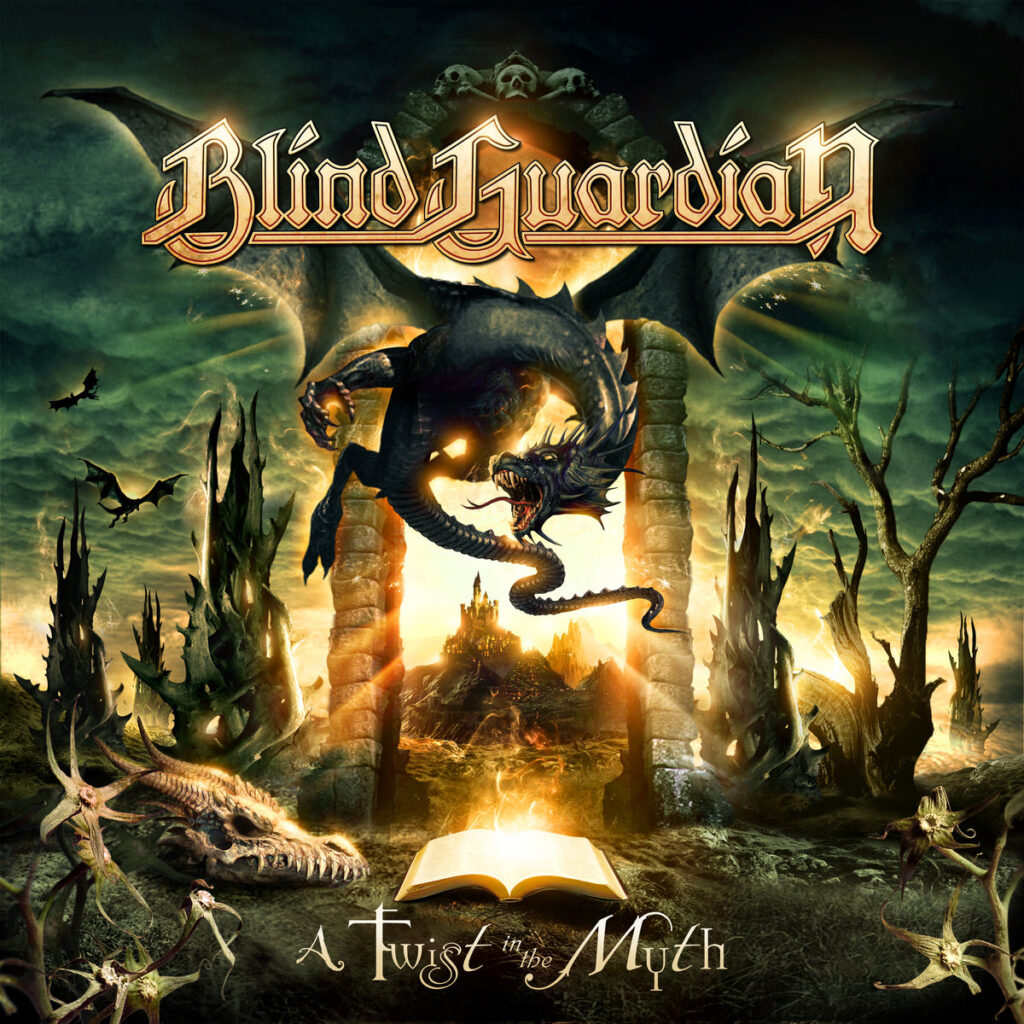
Lyrically, “A Twist in the Myth” also continued to show that BLIND GUARDIAN had moved beyond being simply a band associated with Tolkien and traditional fantasy. The album explores a variety of subjects and literary influences, giving the songs their own identities rather than relying on one overarching fantasy narrative. Even when the cover artwork suggested a return to familiar territory, the music itself made it clear that the band was still looking forward.
“The Edge” provides one of the album’s heavier moments, combining a forceful rhythm section with another huge chorus, while “The New Order” brings the record toward its conclusion with a suitably dramatic atmosphere. Across the album, BLIND GUARDIAN constantly move between direct heavy metal, melodic power metal, progressive ideas and folk influences. It is this mixture that makes the record difficult to place neatly within one category.
Of course, “A Twist in the Myth” was never going to escape comparisons with what came before it. “Nightfall in Middle-Earth,” “Imaginations from the Other Side,” and “A Night at the Opera” had established an extraordinarily high standard, and there were inevitably fans who wanted BLIND GUARDIAN to return to the sound of their classic years. Some listeners found the new album too straightforward, while others welcomed the change and appreciated the fact that the band was still willing to experiment after more than twenty years together. Maybe that is why “A Twist in the Myth” has become more interesting with age.
It is not an album that tries to compete directly with the band’s classics. Instead, it documents a particular moment in BLIND GUARDIAN‘s evolution. A founding member had left, a new drummer had joined, and the band had consciously stepped away from the enormous production and complexity of its previous record. Rather than seeing this as a retreat, it is easier today to hear it as another stage in a career defined by constant movement.
20 years later, “A Twist in the Myth” remains an intriguing chapter in the BLIND GUARDIAN story. It may not have the overwhelming grandeur of “Nightfall in Middle-Earth” or the intricate ambition of “A Night at the Opera,” but that was never really its purpose. This is a record about transition, about finding a new balance between the band’s past and future. And perhaps that is the real twist in the myth. BLIND GUARDIAN did not need to return to the past to prove who they were. They simply continued moving forward.
Written by Peter Jerman
Tracklist
- This Will Never End
- Otherland
- Turn the Page
- Fly
- Carry the Blessed Home
- Another Stranger Me
- Straight Through the Mirror
- Lionheart
- Skalds and Shadows
- The Edge
- The New Order
- Dead Sound of Misery
Lineup
Hansi Kürsch – vocals
André Olbrich – lead guitar, acoustic guitar, rhythm guitar
Marcus Siepen – rhythm guitar, acoustic guitar
Frederik Ehmke – drums, percussion, flute, bagpipes
Guest:
Oliver Holzwarth – bass
Label
Nuclear Blast Records