
Over the years, I’ve noticed that RUSH fans seem pretty devoted to their favorite Canadian prog uncles. Even the band’s most complex prog saga, “Hemispheres” (1978), gets rather unequivocal praise from them, while the uninitiated are guaranteed to have a hard time getting their head around that riff origami. Still, one studio album has managed to drive a subtle wedge between even the most zealous RUSH fans: “Test For Echo,” released on September 10th, 1996, on Anthem Records. On the spectrum of the band’s 1990s albums, quite a few fans position this endeavor close to the not-so-flattering end, next to “Roll the Bones” (1991) rather than “Counterparts” (1993), which was generally regarded as the band’s return to form after an almost decade-long phase of experimenting with all sorts of AOR nuances. Oh, how they must have been mad when this album came out and turned out to be another case of flirting with the college-radio flourishes! Then, the opposing faction dubbed the album a masterpiece right off the bat. That said, even the advocates of a more “mature”-sounding RUSH had to admit that “Test For Echo” is a rather strange combination of songs: the heavier riffers sound almost like leftovers from “Counterparts,” while some of the softer songs sound like nothing the band had released thus far. It could tempt one into thinking that, even though the band had long since abandoned the agenda of pushing the boundaries of progressive rock further into strange, new sonic terrain, they were still doing it – only in a substantially more sneaky-stealthy fashion. Back in 1996, I was still blissfully oblivious about RUSH, so when I found this album some 10 years later, I approached it like any other seminal prog album of the 1990s – and I liked it a lot. How does it work now with the additional weight of 20 more years?
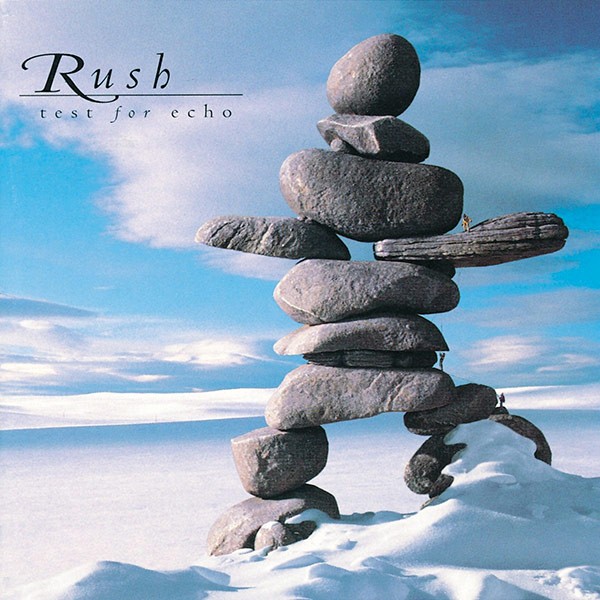
The title track has become a legendary RUSH banger over the years, in part thanks to TOOL‘s guitarist Adam Jones, whose iconic riff in “Lateralus” sounds an awful lot like a slowed-down version of the hooky guitar riff in “Test For Echo.” I wouldn’t say it’s a rip-off, but the similarities are noteworthy enough to suggest that this particular RUSH album must have gotten some heavy rotation in TOOL‘s tour bus. Maybe both songs are just derived from the Fibonacci sequence? Go figure. (In fact, this particular rabbit hole goes deep, my friends; when you take the letters from TOOL and RUSH and put them together in a different order, you get “Hour lost!”) At some point, when fans pointed out the similarities between these iconic riffs, the Internet broke. If truth be told, this online controversy was the main reason for me to check out this album, in the first place. I became a TOOL fanboy somewhere between “Lateralus” and “10,000 Days,” but my relationship with RUSH had been far more reserved. Apart from “Moving Pictures,” I didn’t really care for their earlier stuff, and their later material was practically non-existent for me. This album changed everything. The thing is, “Test For Echo” remains one of the best RUSH bangers to this day, and Alex Lifeson‘s iconic guitar riff isn’t even the sole reason for it. This particular song is one of the most timeless songs the band ever wrote – it could have fit on any of their earlier albums without sounding out of place. Lyrically, instead of musing on some technical aspects of a soundcheck, the song is a critique of the American justice system turning criminals into celebrities.
If the guitar riffs in the album opener inspired one of the most iconic TOOL songs ever, the lyrics throughout the album must have inspired Steven Wilson, in turn, because it’s nigh impossible not to notice certain similarities in terms of style and rhyme. Needless to say, when I finally introduced myself properly to the music of RUSH via this album, I was already a huge fan of PORCUPINE TREE, so this selection was destined to hit a home run. It certainly helped that, after the titular opener, the selection throws in yet another banger without a moment’s notice – “Driven.” The song is driven (sic!) by a kick-ass bassline, yet it uses short pauses to great effect. It’s exactly like a fan once put it online: RUSH did a lot of things right in this song – while it’s not necessarily a 10/10 song given the high standard set by the band’s previous efforts, it certainly is one of the most memorable bangers from the band’s 1990s era.
The first two tracks set the bar pretty high, so it’s no surprise that the next couple of songs felt almost like fillers to some, back in the day. “Time and Motion” steers back to the heavier sound of “Counterparts,” but I reckon it managed to do very little in terms of damage control. I never viewed RUSH as a particularly heavy prog outfit, so I wasn’t actually expecting heavy riffs to speak of. Thus, my relationship with tracks such as “Half the World,” “The Color of Right,” and “Totem” is more open – I kinda understand that they will not be included on the band’s Greatest Hits compilations, but I think they’re pretty decent 1990s-tinted songs, nonetheless. The guitar department, in particular, resonates with the air of the mid-1990s alternative sound, which I liked at the time already. Besides, these oddball tracks (if you ask some of the band’s diehard fans) are placed nicely between the harder-hitting bangers. The acoustic swoon of “Resist,” for example, is placed right before the beefy riffs of “Virtuality.” In my opinion, the pacing works rather nicely here.
Long story short, “Test For Echo” might not be remembered as the band’s magnum opus from the 1990s, but it’s still a pretty good selection of songs – and for such a novice like me, it was every bit as good a deep dive into the band’s sound as some of their more revered album classics. Plus, its title track has one of the best damn guitar riffs on this planet – just ask Adam Jones!
Written by Jani Lehtinen
Tracklist
- Test For Echo
- Driven
- Half the World
- The Color of Right
- Time and Motion
- Totem
- Dog Years
- Virtuality
- Resist
- Limbo
- Carve Away the Stone
Lineup
Geddy Lee – vocals, bass
Neil Peart – drums, percussion
Alex Lifeson – guitars
Label
Anthem Records