
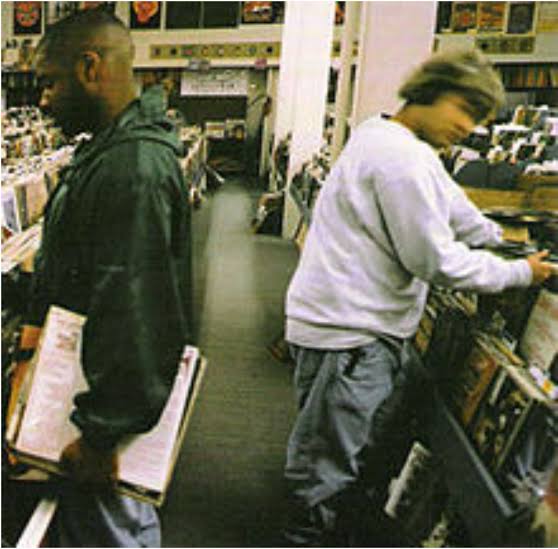
Since I have smudged my reputation already by reviewing all sorts of electronica and trip-hop albums for Tuonela Magazine, I might as well go all-in and review yet another seminal album classic from the golden era of those sweet-scented, smoky beats layered with vintage, vinyl-era samples and brooding, cinematic atmospheres. The thing is, not just anyone could enter the Guinness Book of Records with their debut album, mixing funk, rock, ambient, psychedelia, jazz, vintage prog, and hip-hop – and better yet, by mixing all this in the same bowl without making the sonic brew sound merely like a gimmick. Plus, this album in question had a connection not only to one of the most haunting Finnish prog endeavors from the mid-1970s, but it also greatly influenced the kings of Brit-rock of that era, RADIOHEAD. As it happens, this album celebrates its 30th anniversary on September 16th, so yeah, there’s not a chance I’m going to let this opportunity slip by: I’m gonna Matrix-dive into the crazy sampladelia of DJ Shadow‘s seminal album “Endtroducing…” that detonated the electronic music scene in 1996. What made this particular selection of instrumental hip-hop so stunning was the way it created a highly evocative sense of drama while being almost entirely based on vinyl samples. It’s one thing to push the cut-and-paste culture of hip-hop to its outer limits, and another thing entirely to do so with such an emotional punch. The iconic Akai MPC60 MK2 sampler, used rather prominently throughout this album by Josh Davis, the man behind the artistic alias, had probably never sounded so utterly emotional before. While this explosive debut affair has sometimes been aligned with the trip-hop movement that was all the craze in the UK at the time, I reckon the most important thing that “Endtroducing…” had in common with that epochal Bristol sound was the way these songs were deeply ingrained in hip-hop while transcending the genre’s limits altogether.
As per the conventions of hip-hop, the journey begins with a short skit track, “Best Foot Forward,” which demonstrates Davis‘ scratching prowess. As impressive as this type of sampladelic mayhem may sound, especially when it’s conducted live, it’s no match for what comes next, in terms of hauntology. The first actual song on this album was even rumored to have been the very inspiration for the album opener, “Airbag,” on RADIOHEAD‘s epochal album classic “OK Computer,” which was released in 1997 to become nothing less than the “Dark Side of the Moon” of the 1990s. Well, I’m not so sure whether “Building Steam With A Grain of Salt” was actually the most likely culprit – any of these tracks could have been, to be honest. Especially the songs in which Davis‘ signature chopped beats are more prominent. While the opener has some of those, too, the main hook is a delicious piano ostinato that gets sprinkled with layers upon layers of samples until the point is made very clear: DJ Shadow is not pulling any punches on his debut! Among the best definitions of music that I’ve ever come across, there is one that goes something like this: music is human emotion conveyed through sound. Here, Davis does exactly that with just one piano motif, funky drum beats, and a handful of carefully picked samples – and if that’s not amazing, I don’t know what is.
Every track on this album is crafted with this same formula, but they still sound quite different. “The Number Song,” for instance, is basically crafted around a sequence of samples of people saying numbers aloud – with funky drum beats to boot, of course – while some of the songs take on a substantially more epic footing. For me, the absolute highlight is the track, “Midnight In A Perfect World,” for the obvious reason of sampling the Finnish prog legend, Pekka Pohjola. The song is constructed upon an electric piano chord progression, sampled from the song “Sekoilu Seestyy,” which appeared on Pohjola‘s 1974 sophomore solo album “Harakka Bialoipokku.” The progression itself is very simple: Gm – F – Ebmaj7 – Dm9. In the original version, there is also a jazz-rock-tinged middle section, although the overall magic stemmed largely from the dialogue between Pohjola‘s basslines and the guitar licks of Costi Apetrea. Here, DJ Shadow kept only that haunting chord progression and built an entirely new song around it by layering samples from 13 different songs – David Axelrod‘s “The Human Abstract” and BARAKA‘s “Sower of Seeds,” to name a few.
Among the album’s highlights, we also have “Changeling,” what with those funky and slinky beats and somewhat Twin Peaks-like atmosphere that resonates thick with the grainy air of obscure vinyls of the kind that you could only find in some shady second-hand record store, the owner of which probably looks and sounds just like the famous Log Lady from the said TV series… Then, if “What Does Your Soul Look Like (pt. 4)” and “Stem / Long Stem” failed to tug at your heartstrings, I would seriously doubt whether you were human to begin with.
James Lavelle‘s Mo’ Wax label and its rival Ninja Tune provided nothing short of a haunting soundtrack for the inner-city nightlife around the mid-1990s – and if you condensed that sound into a single album, “Endtroducing…” might as well be the best candidate. On top of that, Josh Davis almost single-handedly established an entire genre of instrumental hip-hop with his haunting debut. Maybe there was some random Ninja Tune or Mo’ Wax artist that beat him to it by a few months or so, but you don’t hear people comparing contemporary records to any of those in this day and age; instead, instrumental hip-hop records are still dubbed “Shadowesque” when they manage to capture the spiritual spheres of this magnificent beast. Ironically, the desire to emulate the sound of a particular artist or a song sometimes fails beautifully, but by doing so creates something even better – an innovation; this is exactly what happened when RADIOHEAD tried to emulate DJ Shadow‘s signature sound. Yeah, sure, the chopped drum beats on “Airbag” sound a bit Shadowesque, but instead of replicating the sound of “Endtroducing…,” they created something even more unique. On a peculiar side note, Josh Davis and Thom Yorke actually had a chance to collaborate on James Lavelle‘s UNKLE project in 1998 – on the haunting standout track and lead single from the “Psyence Fiction” album; “Rabbit In Your Headlights” features DJ Shadow‘s hypnotic pathwork of beats and Yorke‘s signature wailing, and it remains one of the peak moments in the history of trip-hop and electronica. Just like “Endtroducing…” in all of its entirety. I read somewhere that some of the album’s appeal probably stems from the fact that it features no lyrics, save for a few odd vocal samples, alluring the listener to become completely immersed in the somewhat grainy and sepia-filtered, cinematic atmospheres. There is this psychological phenomenon of feeling nostalgia for a time or a place that one has never actually experienced – anemoia. Mr. Davis proved to have one hell of a knack for creating such a feeling by sculpting these sonic cut-and-paste collages from old vinyl samples on his debut album. Someone once said that “Endtroducing…” may mark a moment in time, but the album itself exists outside the constraints of time altogether. ‘Nuff said. This album is a timeless masterpiece.
Written by Jani Lehtinen
Tracklist
- Best Foot Forward
- Building Steam With A Grain of Salt
- The Number Song
- Changeling
- Transmission 1
- What Does Your Soul Look Like? (Pt. 4)
- 6.
- Stem / Long Stem
- Transmission 2
- Mutual Slump
- Organ Donor
- Why Hip Hop Sucks in ’96
- Midnight in A Perfect World
- Napalm Brain / Scattered Brain
- What Does Your Soul Look Like? (Pt. 1 – Blue Sky Revisit)
- Transmission 3
Lineup
DJ Shadow – Akai MPC60 MK2 sampler, Technics SL-1200 turntables, ADAT
Label
Mo’ Wax Records