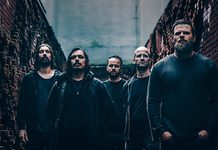

Ankea Festival brought EARTHSIDE over to Finland for two shows: one at On the Rocks in Helsinki, and one at the inaugural edition of Ankea Festival on June 5th, 2026. We had the opportunity to talk to guitarist Jamie van Dyck and drummer Ben Shanbrom at the festival and chatted about their European tour, their live shows, the new EARTHSIDE era, and much more. Watch the complete interview here or read the transcript below.
All right, well, thank you so much for taking the time to do this interview. How are you guys doing today?
Jamie: Really good. I mean, it’s great to do the interview after we’ve played and get to… You don’t always want to be one of the first bands of a festival, but on the positive side, it’s like you came to do your business, and now you just get to relax. There’s a sauna here. We can really feel like we’re a little bit on vacation now, the rest of the way, rather than having to be like, “Oh God, I hope we don’t screw it up.” Yeah.
Ben: There’s definitely some nerves before playing a festival date that whenever you have an interview before, you’re like, half of your brain is not really there, and people are asking, like, “Oh, what inspires you?” and “How exciting?” I’m just thinking about these three parts that I can’t screw up. But no, it feels really good to be here. Yeah. Very powerful atmosphere on stage at Ankea. Yeah.
Well, did you screw the parts up that you were worried about?
Ben: What were the three parts I was worried about? Not really. That would be my answer, I think.
Jamie: I heard one snare hit that wasn’t as hard as it’s supposed to be.
Shame on you.
Ben: It’s too bad. It’s too bad that I had to hit everything on the drum set right before it.
Yeah. Well, I heard that, well, you also mentioned it, but I heard it before, that this festival is the reason you were able to do your European tour. Yeah.
Jamie: I mean, it also created the cause. It’s like we’ve been wanting to do a European tour, but there’s sort of a chicken-and-egg situation. It’s like, oh, you need a booking agent to sort of book a tour, but a booking agent won’t take us on because they don’t know what we’re worth. So I think being able to do this tour will hopefully open up doors for promoters to feel more confident booking us in the future. It’s kind of the “how the sausage is made” part of the music industry.
And so in saying yes to this festival, which was an immediate yes for us, because when we saw the vibe of this festival and, you know, Finland may be the country with our highest concentration of fans according to the numbers. And we’ve never been here before. We’ve played other shows in Europe. We’ve never been here. So this was an obvious yes.
Then it was a matter of first waiting to see if another band that was maybe part of the festival, or had a tour around the same time as this festival, that we could jump on, and then have that be part of a tour around this festival. That didn’t happen. So with a handful of months to go before this, we were just like, let’s do it. We talked to our manager about it, and she put her booking agent hat on for the first time in her life.
Our manager, Lulu Davis, helped get VOYAGER on Eurovision. So when she puts her mind to something, she gets things for her bands, and people don’t say no to her, or at their own peril, they do. Thus, we were booked for tour dates, and we got to have Raphael Weinroth-Browne as our support act on the tour. Then he joins us on stage, and here he was not one of the acts booked, maybe next year at Ankea Festival, but we had Raphael on stage with us, and it was just really special.
I think it made this a unique tour as our first European headline tour. We’d never had a live cello on stage with us before. And I think getting to make this extra special was just really cool.
Ben: This was probably the only set where almost the entire set we had the cello with us.
Jamie: We had it all but one song. All but one song is totally without cello. Yeah.
I was surprised because I obviously have never seen you live, because you don’t really play in Europe. But I was surprised to hear that whenever you have a guest featuring on the music, you also decide to include them. Is there a reason you do that?
Jamie: I mean, I guess the alternative would be either to play the songs instrumentally. Some songs, I think, would work better than others instrumentally. Like, we didn’t play our song Mob Mentality today, but if we did that song without the backing track, it would be like, “All right, and here there is just silence for 10 seconds.”
So I think it’s a big part of the composition. And also, in a lot of cases, the sound of the singer’s voice is the right voice for that song. I think it would be very hard. The other option would be to get a live singer, which we may do at some point. We’ve certainly not written it off, but it would take a unique person to be able to sing multiple of our songs.
I think as we write more, perhaps we will have a set of songs where the same singer would sound good on all of them. And then we also may write more instrumentals, so we can lean more into instrumentals on our set.
These are things we’re constantly having to think about as a band with a counterintuitive way of approaching this. But yeah, especially with this festival having the screen behind us, I think it helps capture the collaborative aspect of how we do things.
Ben: I think we try to treat, to the extent that we have collaborators that you’re not seeing in the flesh with us, the show as an overall immersive multimedia experience. The music is obviously the central focus, but we’re very inspired, and we’re not shy about saying this, by Hans Zimmer and the experience of the live show that he puts on, where it’s this full-on event.
It’s not like you’re just going to see a music concert. It’s this complete synergy between lights, visuals, and all these different instrumentalists across the stage. Obviously, to the extent that we can be inspired by that, we have to do it on a bit of a smaller scale.
But whether it’s bringing a person like Raph out with us, working with a very talented lighting person, and using screens, we try to make every show feel like more than just seeing a rock or metal band. More like an experience.
Yeah. When it comes to the guests you bring into your music, is it people you’re a fan of, or people you admire, or does it depend only on the song? I don’t think they’re people you hate. It would be a first.
Ben: I don’t think it’s people we hate.
Jamie: I mean, I think sometimes there are people we don’t already have a relationship with, where we have to build it through contacting them, cold-contacting them, and saying, “We love your work. We think you’d be a really great fit for this song.”
In other cases, there is already a relationship there. I think more and more, especially as we do this longer, we develop more relationships. Whereas on our first record, we didn’t have many relationships, so that was much more on the cold-contact side.
As we go, we can lean more on collaborating with people we organically already have a mutual admiration with, where it is already there and we don’t have to cultivate it.
But yeah, certainly we’ve gotten to work with singers we really love. The main thing is, we generally view it as: what will serve each song? When we write a song, it’s what does this song need, and who would elevate the emotional experience of this piece of music as we conceived it?
Ben: Or who would create an experience that would be very different from either any collaboration that person had done before or just a really interesting musical experiment that no other band has done. I think that certainly goes into the calculus of picking our collaborators.
Now, I guess this tour is kind of wrapping up the “Let the Truth Speak“ era. And you’ve already also released a new single. I don’t know if you can answer already, but is there something more coming soon?
Ben: Yeah, I mean, the intention is certainly that there’s more on the way. You’re right to say that it is indicative of a new era. It’s the first thing that we’ve released that is completely separate from the “Let the Truth Speak” era.
We’ve released a couple of singles in the last couple of years that were like a bonus track from “Let the Truth Speak” or a reimagining of a “Let the Truth Speak” song. And this was the first brand-new thing. It was written in a completely different way, recorded in completely different studios.
But yeah, it’s part of a bunch of new material that we kind of have kicking around, and we have to go home and finish writing and recording that material.
Ever since the release of “Let the Truth Speak,” we’ve really had the mission in mind of: we’re back, we’re doing this with full abandon, and we’re not going away again.
So this has been an incredible experience, coming to Europe and bringing that new song and new material to the audiences over here. And “A Dying Star” is kind of part of that promise that EARTHSIDE is full steam ahead, and it’s not going to be long before there’s a lot of new material coming out.
Well, how have the audiences reacted to the song in general? Did you notice anything?
Ben: I think it’s a little hard to say. I think overall it’s been positive, but we have the special transition out of that song where I hit the last drum hit and then there’s this, like… and then we’re right into the next song.
Jamie: Yeah. And it’s a song that’s played after one of our most beloved songs, “We Who Lament.” So it’s hard to tell what’s a celebration of “Oh, this new song was really good” versus “Oh, ‘We Who Lament’? Hell yeah.”
I think before we even get a chance for the audience to let us know, “We Who Lament” kind of takes the torch and runs.
It’s also different today because today we opened with “A Dying Star.” The rest of the tour, we had a song before “A Dying Star.” I do think audiences tend to ramp up. So today it wasn’t until a couple songs in where you really got a sense that the audience was in it with us.
By the end of “A Dying Star” on the rest of the tour, it’s already the second song and our songs average eight, nine, ten minutes anyway. So now you’re really talking deep into the set.
I think on the rest of the tour, “A Dying Star” was really going over well, especially having a song before it to get them into it. I think it went over well today too. The audience just wasn’t able to show it in the same way by virtue of it being the first song.
Ben: Yeah, but I think it is emblematic of us putting a bit more thought and focus into writing songs that we feel are going to be very powerful and translate live in an effective way.
What’s been classically the EARTHSIDE writing method is: we have a good idea or we’ve written something cool together, and we’re just going to make the coolest songs we possibly can. We’ll sort of figure out how we’re going to do it live after the fact.
Something that we really view as a big focus is taking our live show to the next level and having more material that has a bit more immediacy in a live environment, and a bit more explosive and consistent energy.
That was certainly a big driver with “A Dying Star,” and I think it will probably also be pretty present in the new material as well.
Jamie: In general, some of our songs we write together in rehearsal, and then others are one of us or two of us just in Logic or Pro Tools, writing it, demoing it, and then bringing it to the band.
By virtue of the songs we write in rehearsal, generally people write their own parts. They’re playing it on an instrument rather than programming it on a computer. So the songs that have that in-the-moment synergy together in a room as part of the creative process tend to be the songs that translate best live or require less thought to play live. Not always.
Ben: Until someone else intervenes.
Jamie: Yeah. But making sure that continues to be a staple of our writing process is important because as our lives go on, there are more considerations. Does somebody want to live somewhere else? There are more adult-life things that may move us apart.
So how do we get that synergy in writing? We have to protect some time where we are together in a room writing together.
Those are considerations when we get home from this. Because we’ve had this tour, and now when we get home from this tour and this festival, it’s like, all right, there is nothing until we finish this album.
I’ve been telling my bandmates, because we’ve got a couple of shiny offers, and I’m like, “Say no. Say no.” Because we need to be disciplined. We have to finish it, or at least have a real timeline to finish our next album.
So it’s not a repeat of what happened before and really prove to ourselves that we can be lean and mean in the process. Not that we hold back on creative ambition and inspiration, but having a real structure by which we work so that we can have that productivity and feel more accomplished and then get back to these moments faster.
Because in order to really build on this tour, I think having a new album out sooner would allow us to have momentum from this and come back here much sooner and not be strangers to Finland.
Well, you now have the visa anyway, so it would be nice.
Jamie: Is that how it works? Maybe that’s true.
Yeah, there was a moment there when you were describing your process and you said not all songs. So I’m wondering what is the song you had in your mind that he doesn’t like?
Jamie: Oh, no, no. You mean when I was talking about when somebody intervenes? It’s more like there’s a song in our set that today he’s hoping is the last time we play it for a little while.
Lucky for you, we’re not going to have any shows coming up. We’re going to do our own thing and then you can love it all anew.
But there’s a song where we did write it mostly in rehearsal together. Frank was like, “Ben, at this climax, at the end, just play everything. Like, the most crazy.”
Ben: Yeah. I had an ending worked out that I was like, “All right, this is going to be cool.” I’m doing all this crazy stuff before it and then this is going to open up and be a nice ride out.
And he was like…
Jamie: And I tried a few things. I was like, “Oh, you want this?” And he was like, “Yeah, yeah, that.”
I was like, “No, that wasn’t an option. That was me trolling.”
And he’s like, “No, no, that’s the thing.”
And that’s happened in a few songs. Jamie can make my life difficult.
Jamie: Usually when I make your life difficult, it’s not in songs we write together in rehearsal.
Ben: Yeah, no, you do it on the laptop.
Jamie: Yeah. It’ll be like, “Oh…” That’s when I’m being a mad scientist.
Ben: And he has the least knowledge of actually playing drums.
Jamie: Excuse me?!
Ben: You have the most naturally remarkable drumming style.
Jamie: But I calculate your drum beats.
Ben: Yeah. So Jamie can come up with challenging beats to figure out how to play. But Frank will come in and be like, “No, you need to do the craziest thing ever after 10 minutes of crazy drumming.”
Jamie: We want the world to know how great you are. What better way than after 10 minutes of beating it into the audience’s head that you’re a great drummer than making it even more the case?
Like, yeah, play the hardest thing ever after that. And if you pull it off, it’s like a figure skater who’s had a really hard routine and then ends with a quadruple axle or whatever they’re called.
If you hit it, people go, “Wow, really good.”
And if you don’t, it’s like, “Well, it’s a quadruple. What do you expect?”
I always say never let a keyboard player write a vocal line, but I guess it works for drums. Maybe that’s why you’re an instrumental band.
Jamie: Now, we torture vocalists too, but at least they don’t have to stick around to try to do it live.
Yeah, that’s a nice ad for your band.
Jamie: Come sing for us. We will torture you.
Anyway, it’s almost time, so before we wrap up, is there anything you want to still share with your fans?
Jamie: We’ve been dreaming of coming here. We have played Europe. I know we’ve not played Europe much, but we were supposed to have a tour in 2023 in Europe and then some circumstances intervened, to put it lightly.
But it’s so good to finally be playing Finland and be able to do this. And I hope we can harness this feeling as motivation to come home, maybe be in our secret labs for a few months where we don’t get that gratification, but harness what it feels like to be able to do this so that we come back and resurface.
Let’s do this with a set that includes new music that feels very present to us.
Ben: For us, making music that I find very emotionally powerful is the most important thing. But music is meant to be shared, and there’s nothing more gratifying for us than sharing the music that we make, especially in a live environment, with fans we have and new listeners.
This has all reminded us how important that is. And there’s no doubt in my mind that we will be back very soon.
Jamie: Not even a little?
Ben: There’s a little doubt.
Jamie: Okay, let’s see. We have to prove it to ourselves and then we can prove it to everyone.
Ben: There’s very little doubt that we will be back very soon to share a lot of new music and powerful live performances with everyone.
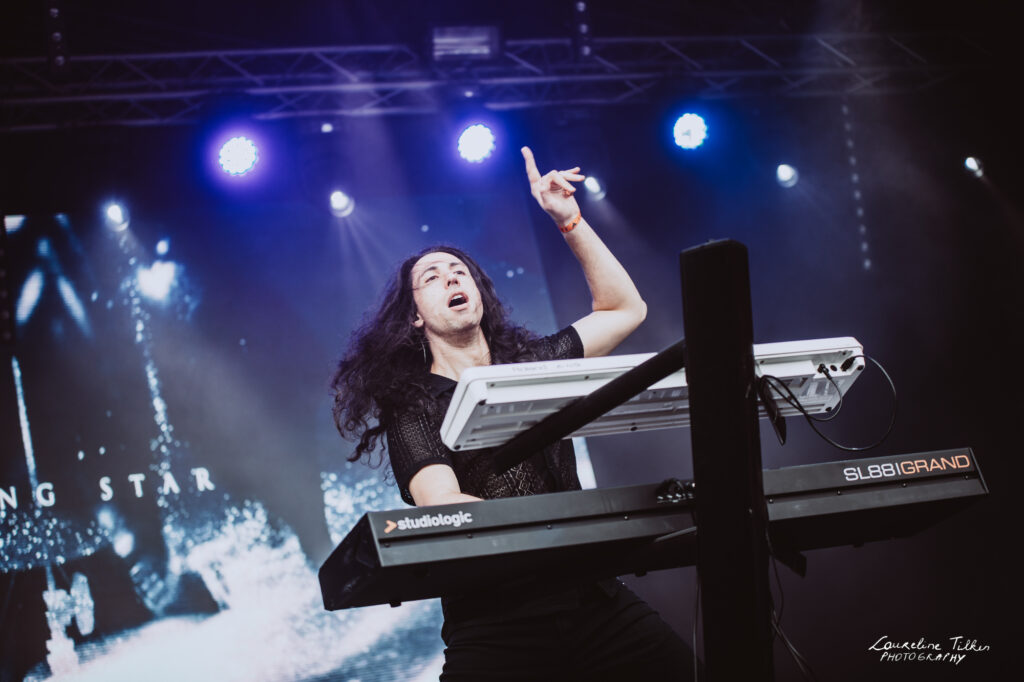
Interview by Laureline Tilkin