

Apparently, the year 1975 must have been a real cornucopia of quality releases since I don’t think I’ve ever written so many 50th anniversary reviews during my 5 years of being a journo at Tuonela Magazine as in these past several months. The latest in my ongoing series is the first studio album by Steve Hackett, “Voyage of the Acolyte,” which also marked his only solo effort recorded and released while still a full member of GENESIS. The recording sessions took place around June and July 1975, immediately after The Lamb Lies Down on Broadway concert tour by that British prog dinosaur. This was perhaps the reason why this endeavor featured two other GENESIS musicians, namely Mike Rutherford on the 12-string guitar and Phil Collins on drums and vocals. With them on board, this album does resonate with the air of almost being a “lost” GENESIS album, bridging “The Lamb Lies Down on Broadway” (1974) and “A Trick of the Tail” (1977). Some fans have even gone as far as to say that the only decidedly “Not-GENESIS” thing about this album is the choice of synth timbres; I believe the synth patches came predominantly from ARP 2600, as stated in the album’s liner notes, whereas Tony Banks used the brighter-sounding Pro Soloist synth in GENESIS at the time.
As per the conventions of the British progressive rock movement of the 1970s, this album is a conceptual affair, with each song inspired and titled by the deck of Tarot cards. With this in mind, it is no surprise that the music conjures up beguiling imagery of witchcraft, Celtic magic, and old medieval castles. Since I’m not adept at the art of Tarot, I had to consult the Internet to figure out the meaning of each of these cards referred to in the song titles. So, a disclaimer might be in order here: take my words with a grain of salt. It appears that the Major Arcana cards of the Tarot deck comprise a metaphoric journey through life – the Fool’s journey – with each card standing for a stage on that spiritual journey. Apart from the album opener, each song is titled after one of these Major Arcana cards. The song order does not follow the order of the cards in the Tarot deck, and I’m guessing it was a rather deliberate choice on Hackett‘s part: this particular order in the tracklist suggests an overarching narrative. I had to consult Google’s Co-Pilot on the meaning of this particular Tarot spread, and it suggested a powerful journey of transformation, beginning with a bold new idea (Ace of Wands) that requires intuitive guidance (High Priestess) to navigate through stormy waters (The Tower) and with better intuition (High Priestess, again) arrive at some profound personal reflection (The Hermit). Then, this leads to a period of hope and spiritual renewal (The Star), a significant relationship (The Lovers), and the establishment of a new wisdom (The Hierophant). A seasoned Tarot card reader may disagree, but I’ll stick to this interpretation for the sake of this review. Let’s see how the music unfolds in accordance with this…
It’s pretty easy to see why the first song on Hackett‘s first solo album bears such a title as “Ace of Wands,” signifying a new beginning. The consensus was that Peter Gabriel was the leading creative and musical force in GENESIS, but as this solo endeavor quite rightly demonstrates, Hackett was no less talented in songwriting. He would eventually leave GENESIS two years later because he felt his creative input was not really appreciated. This album opener is a mission statement, and a pretty slapping one at that, alternating between symphonic prog riffages and pastoral passages.
The 2-part suite, “Hands of the Priestess,” is a thoroughly pastoral moodpiece, with the flute melody in part 1 traversing somewhat “Firth of Fifth”-esque terrain, especially the solo section in that GENESIS classic – and Hackett‘s solo in that particular song remains to this day one of the best guitar solos ever. The High Priestess is a Major Arcana card of mystery and stillness, so this plays out rather nicely. The latter part takes on a tad more Medieval tangent, and, sandwiched in between, “A Tower Struck Down” captures the sentiment of a crisis of some sort quite well with its odd syncopations and surreal synth textures. The Tower is the sixteenth Major Arcana card, commonly interpreted as a marker for danger or sudden unforeseen changes.
Regarded as one of Hackett‘s best pastoral tracks, “The Hermit” conveys the mood of introspection down to a tee. The lyrics are pretty cryptic, echoing a somewhat Tolkien-esque air of fantasy, what with its verses such as “Enshrouded by darkness, a figure slowly forms / Through many years of banishment, no shelter from the storm / to find this slave of solitude, you’ll know him by his star / Then take his hand, he’ll lose himself, knowing who you are…” The namesake Tarot card symbolizes inner reflection and spiritual enlightenment in solitude. With Robert Plant on vocals, this could be an LED ZEPPELIN number. This song leads nicely to the pastoral first half of “Star of Sirius,” which eventually gives way to a punchier prog jam in the spirit of CAMEL. The song’s predominant mood is one of hope, as also hinted at by the corresponding Tarot card.
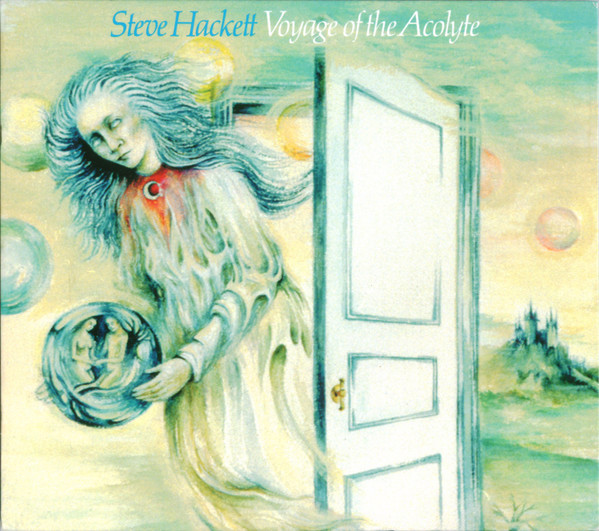
For some reason, “The Lovers” is merely an acoustic interlude. I mean, isn’t love a rather big topic for a song?! The meaning behind the Tarot card is a no-brainer, even for such a layman as myself, albeit I did find out that the card symbolizes something a tad more complex than just hooking up with someone. Then again, since when has love been easy exactly? On a side note: the cover art for this album was created by Brazilian artist Kim Poor, who became Hackett’s wife in the early 1980s – the cover was voted Best Music Album Cover in 1976.
Befittingly, the absolute standout track, “Shadow of the Hierophant,” brings the album to a close. Legend has it that the song was originally rehearsed by GENESIS during the making of their 1972 album “Foxtrot.” The song does resonate quite thick with the aura of Gabriel-era GENESIS, so it’s baffling why it never made the cut for that album. The song is pure Mellotron-laden prog candy that falls in line with the holy tenets of the symphonic prog of the era. It stands to reason: The Hierophant of the Tarot deck is a card that stands for tradition and convention. Considering the high quality of this album, it’s quite peculiar that I didn’t find out about it until the early 2000s, even though I had an obsessive prog phase in the 1990s – and it seems that I wasn’t the only one: this album has remained something of a buried treasure for prog fans outside the sphere of the most diehard GENESIS aficionados.
Written by Jani Lehtinen
Tracklist
- Ace of Wands
- Hands of the Priestess, part 1
- A Tower Struck Down
- Hands of the Priestess, part 2
- The Hermit
- Star of Sirius
- The Lovers
- Shadow of the Hierophant
Lineup
Steve Hackett – guitars, Mellotron, harmonium, bells, autoharp, effects, vocals
Sally Oldfield – vocals on tracks 8 and 10
John Acock – Elka Rhapsody synthesizer, Mellotron, harmonium, piano
Mike Rutherford – bass, bass pedals, fuzz 12-string guitar
Percy Jones – bass on track 3
Johnny Gustafson – bass on track 6
Phil Collins – drums, vibes, percussion, vocals on track 6
John Hackett – flute, ARP synthesizer, bells
Robin Miller – oboe on track 6, cor anglais on track 5
Nigel Warren-Green – cello on track 5
Label
Charisma Records