

This year marks the 30th anniversary of “The X Factor”, IRON MAIDEN’s tenth studio album, released on October 2nd, 1995. It arrived during a period of turbulence and transformation for the band. Bruce Dickinson had departed, and Blaze Bayley stepped into the role of lead vocalist, a change that immediately set expectations high while fueling skepticism among fans and critics alike.
The album also coincided with a difficult personal chapter for bassist and chief songwriter Steve Harris, who was navigating both the end of his marriage and the loss of his father. These experiences left a deep imprint on the writing process, shaping the album’s atmosphere and lyrical themes. The result was a record that stood apart from anything the band had produced before, slower in tempo, more expansive in structure, and consistently darker in tone. Rather than the energetic pacing and heroic imagery that had long defined IRON MAINDEN, “The X Factor” delved into war, disillusionment, mortality, and personal struggle, creating a cohesion rooted in gravity and reflection rather than escapism.
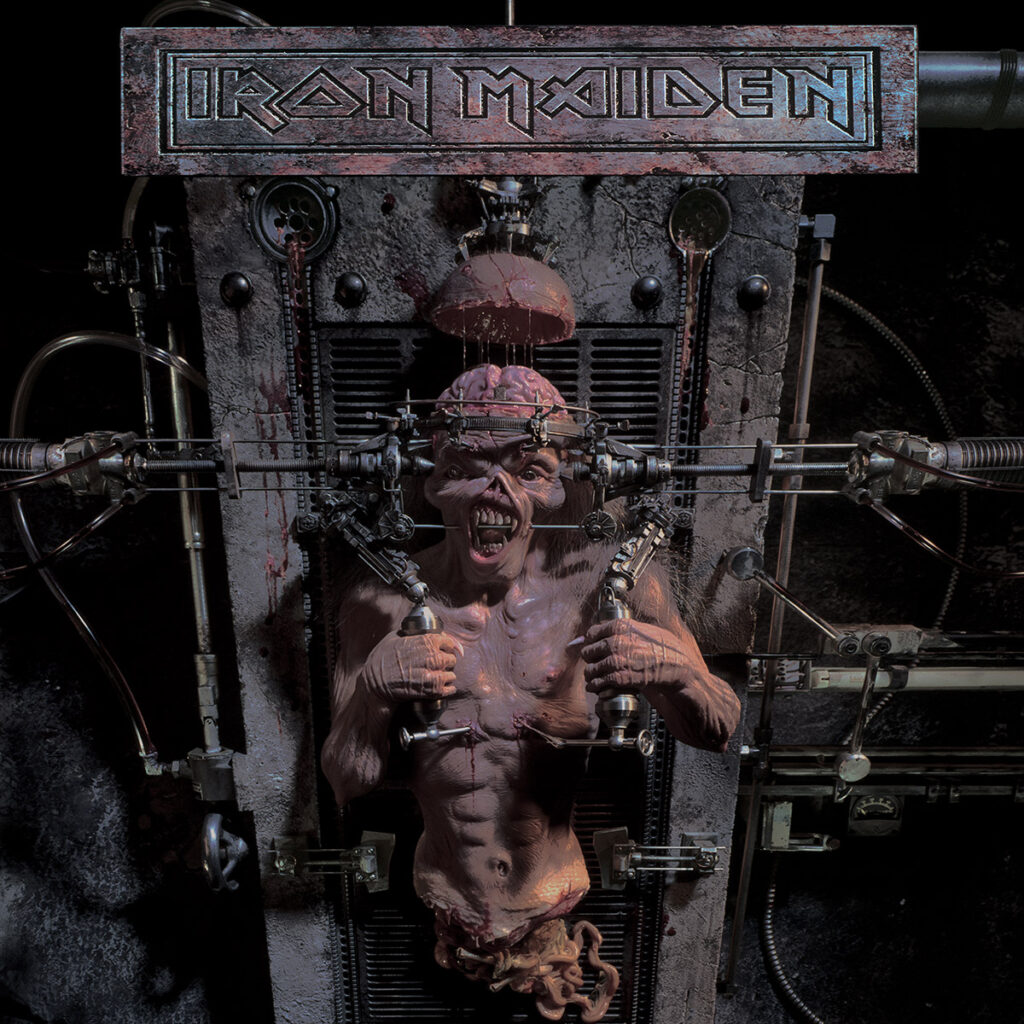
The visual presentation reinforced this departure. The cover, created by artist Hugh Syme, depicted Eddie in a disturbingly realistic surgical scenario, restrained and subjected to a gruesome medical procedure. Its severe, graphic quality contrasted sharply with the more fantastical artwork of earlier albums, to the point that a toned-down version had to be issued for certain markets. Just like the music itself, the imagery reflected IRON MAIDEN’s willingness to unsettle expectations and confront their audience with something more somber and uncompromising than they had ever attempted before.
Among the album’s standout opening track, “Sign of the Cross” emerges as an epic centerpiece, a sprawling ten-minute journey that immerses the listener in an atmosphere of foreboding and spiritual introspection. Its slow-building but powerful introduction, haunted by melodic guitar harmonies and simmering bass lines, gives way to dramatic shifts in tempo and intensity. Blaze Bayley’s deep, brooding vocals navigate the song’s labyrinthine narrative with a sense of solemn gravitas, while the layered guitars create a cinematic texture that evokes ancient cathedrals and shadowed corridors. The song’s epic structure, punctuated by quiet reflective passages and explosive climaxes, leaves a lingering impression of grandeur and melancholy.
“Man on the Edge” offers a more immediate, aggressive punch. Driven by a propulsive riff and thunderous rhythm section, it captures a sense of frustration and societal disillusionment, inspired by the chaos of its cinematic muse, “Falling Down”. Bayley’s vocal delivery, urgent and raw, conveys the tension of a character teetering on the brink, while the guitars deliver sharp, biting accents that keep the energy taut. It’s a song that marries MAIDEN’s traditional intensity with a modern, almost narrative urgency, making it one of the album’s more accessible yet thematically weighty tracks.
“Lord of the Flies” channels the savage chaos of Golding’s classic novel, translating it into a tense, rhythmic assault. The track alternates between contemplative verses and explosive choruses, mirroring the descent into anarchy that the lyrics explore. Bayley’s somber voice carries a sense of foreboding, while the dual guitars weave intricate motifs that echo the story’s underlying darkness. The song is relentless yet thoughtful, a study in tension and release that underscores the band’s compositional ambition.
Deeper cuts like “Blood on the World’s Hands,” “Fortunes of War,” and “The Unbeliever” showcase the album’s emotional core. Blood on the World’s Hands is a mournful meditation on conflict and human suffering, with a somber melody and subtle dynamic shifts that draw the listener into its grim narrative. “Fortunes of War” juxtaposes melodic guitar lines with dark lyrical reflections on fate and the consequences of human choices, its ebb and flow mirroring the unpredictability of life itself. “The Unbeliever” closes the album with a contemplative, almost elegiac quality, its restrained instrumentation allowing the weight of the lyrics and Bayley’s haunting vocals to resonate fully. Together, these tracks reveal the depth of emotion and thematic sophistication that rewards careful, repeated listening, cementing “The X Factor” as a work of both darkness and beauty.
At the time of release, reception was mixed. Critics cited a perceived loss of energy and the challenge of adjusting to Bayley’s voice. Yet with the passing decades, “The X Factor” has garnered a more sympathetic reappraisal. Fans and newcomers alike recognize its authenticity, its willingness to diverge from expectation, and the raw emotional honesty that courses through each track. Blaze Bayley himself has reflected on the album’s darkness, acknowledging that while it may have alienated some listeners initially, it has resonated deeply in many parts of the world.
Revisiting “The X Factor”, one discovers an album that refuses to be simple or conventional. It is a courageous exploration of vulnerability, transition, and artistic growth, a work defined by brooding textures, uneven pacing, and moments of intense emotional depth. More than a collection of songs, it stands as a testament to resilience and a quietly powerful chapter in IRON MAIDEN’s storied career. Its legacy lies not in conformity, but in the bravery of embracing change, and in doing so, laying the groundwork for the band’s future triumphs.
Written by Peter Jerman
Tracklist
- Sign of the Cross
- Lord of the Flies
- Man on the Edge
- Fortunes of War
- Look for the Truth
- The Aftermath
- Judgement of Heaven
- Blood on the World’s Hands
- The Edge of Darkness
- 2 A.M.
- The Unbeliever
Lineup
Blaze Bayley – vocals
Dave Murray – guitars
Janick Gers – guitars
Steve Harris – bass, production, mixing
Nicko McBrain – drums
Label
EMI